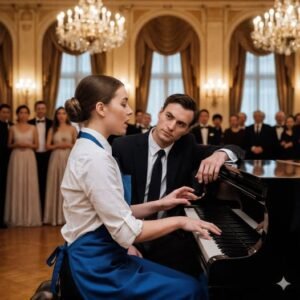
Julia could barely believe that all this was really happening. Yesterday she was washing the floors, dreaming of touching the music at least for a moment, and today she was standing in the center of the hall, surrounded by admiring glances.
“I… I don’t know what to say,” she whispered, still not believing that she deserved the applause.
The director of the conservatory smiled encouragingly:
– Please say yes. We will take care of the rest.
Her lips twitched. She wanted to agree, but fear held her back. The image of my grandmother came to my mind – sick, tired, in need of constant care.
“My grandmother…” Julia began. -I can’t leave her alone.
“We’ll solve this problem,” said the elegant woman, the same one who approached her first. — I have contacts in the clinic, they will provide care for your grandmother and a comfortable apartment close to you.
Julia felt her throat tighten with gratitude. She nodded, not trusting her own voice.
At this moment, the staff manager returned to the room. He tried to protest:
— Excuse me, ladies and gentlemen, but this girl works here as a cleaner. He has a contract.
-Contract? – the director of the conservatory smiled ironically. — I think a new, much more important contract is just beginning in her life.
Laughter rippled through the room. People looked at Julia no longer as a servant, but as the discovery of the evening.
Two days later, her life changed. She was given a room in a dormitory near the conservatory, and her grandmother was provided with a cozy place in a nursing home nearby, where doctors and nurses took care of her. Julia visited her every day, bringing stories of new experiences.
The first class was a challenge. There were students sitting around who had been studying with the best teachers for years. Their hands flew over the keys confidently, without hesitation. Julia felt alien.
“Begin,” said the professor gently, a gray-haired man with kind eyes.
She sat down at the piano. Her fingers trembled, but as the first notes sounded, everything else disappeared. Music became her refuge again. When she finished, the class fell silent. Nobody laughed. On the contrary, my colleagues started clapping.
“You have a rare gift,” said the professor. — It is not the technique that makes a musician great, but the soul. Technology comes with time, the soul either exists or it doesn’t. The lady has it.
These words gave Julia strength. She practiced from morning to evening: she played scales, read scores, and learned to breathe with the music. Sometimes she fainted from exhaustion, but she never gave up.
After a few months, she was invited to perform at a student concert. It was her first performance on stage as a conservatory student. She was trembling as much as she had that night at the ball, but when she looked out into the audience, she saw her grandmother in the front row. She sat in an armchair, wrapped in a woolen scarf, and smiled.
Julia took a deep breath and started playing. The music flowed cleanly, freely, as if it had always been waiting for this moment. The room listened intently.
After the concert, a professor approached her.
“I want you to take part in an international competition,” he said. — This is a chance to show ourselves not only here, but also throughout Europe.
Julia turned pale. The word “competition” itself sounded terrifying, but her grandmother squeezed her hand and whispered:
– This is your way. Don’t be afraid.
The competition took place in Vienna. A huge hall, a jury composed of famous musicians, an audience from all over the world. Julia came on stage in a simple black dress. She knew: she wouldn’t surprise anyone with her splendor, but music could do anything.
When the first notes rang out, she felt like her entire journey – from the night in the small apartment to the humiliation at the ball – melted into this melody. Each movement of the fingers was a declaration of love for music and for life.
After the last chord, the hall rose to its feet. The applause was deafening. Some people cried.
The jury unanimously awarded her the first prize. Her name rang throughout the hall, and her photos appeared in newspapers and websites.
After returning home, Julia first ran to her grandmother. She was holding a fresh newspaper with her photo in her hands.
“I always knew you were special,” Grandma said, her eyes shining with tears.
Julia embraced her, feeling that now they both had a future.
She was no longer the invisible cleaning lady. She became a musician whose music was born from pain, hope and love. A musician heard all over the world.